

This Chamber of Curiosity is a 'pokey' one - buckle in. You may have heard of the psychiatrist Irvin Yalom. Throughout his work, he references the “givens of existence” - core aspects of human life that are inescapable and anxiety‑provoking. (Yes, anxiety‑provoking… Every single human experiences, - and in fact requires - a level of anxiety to remain alive – deep dive into The Chamber of Curiosity around Anxiety coming soon)
Within the space I’m holding to explore my curiosities, I’ve been sitting with the idea that our attempts to make sense of life are often based on emotional responses we then use as evidence to decide whether experiences are “good” or “bad”. From there, we draw conclusions - subjective ones - and treat them as truth.
Lately, I’ve been trying to step back from that. To practise accepting that some facts of human life cannot be classified or categorised - at least not objectively - because they simply are.
(And yes, this concept has kept me awake at night. Those restless hours have become the foundations of my thinking around radical acceptance - what it means, and what it might offer my lived experience. But that’s for another day.)
Whether comforting, painful, reassuring, ugly, or all of the above, there are certain givens that connect us as humans. Shared ground we don’t opt into but still inhabit. It’s suggested that an authentic life is shaped by how we experience, face, and respond to these unavoidable facts:
- We are responsible for our own lives and actions, paired with a radical freedom to choose.
- We are born alone and we die alone. Regardless of our relationships, our experiences are ultimately confronted independently.
- There is no inherent or predetermined meaning, so we must create our own.
- Everything comes - and everything goes. We are all born, and we all die.
Freedom & Responsibility.
Isolation.
Meaning & Meaninglessness.
Death.
I did warn you - they aren’t reassuring on the surface.
So why am I telling you this? …It’s because I keep circling back to one of these givens: death.
Every human who has ever existed, will ever exist, or exists right now is born and will die. Morbid? Yes. Raw? Absolutely. Reassuring? Not at first glance. But universal? Completely.
And because death exists, grief exists.
We will lose people. Animals. Relationships. Roles. Homes. Routines. Beliefs. Versions of ourselves. We grieve jobs, teams, identities, faiths, stages of life. We grieve the living as relationships shift. We grieve futures that never materialise. Sometimes we grieve things we never even had - unmet needs, missed chances, imagined possibilities.
Grief does not care for boundaries.
After multiple significant and unexpected losses in my own story - and after sitting alongside others in theirs - I’ve noticed how quick we are to reach for reassurance:
Things will get better.
Stay strong.
It will get easier.
Time is a healer.
I’m not innocent here. I’ve wanted to rescue, to fix, to soften the pain for people I love. The intention is never cruel - it’s hopeful. But when I’m the one grieving, I don’t want my feelings changed. I want company in the darkness. I want to be met where I am. I want my shit feelings validated.
That tension made me stop and ask: where did the idea that “time heals” even come from?
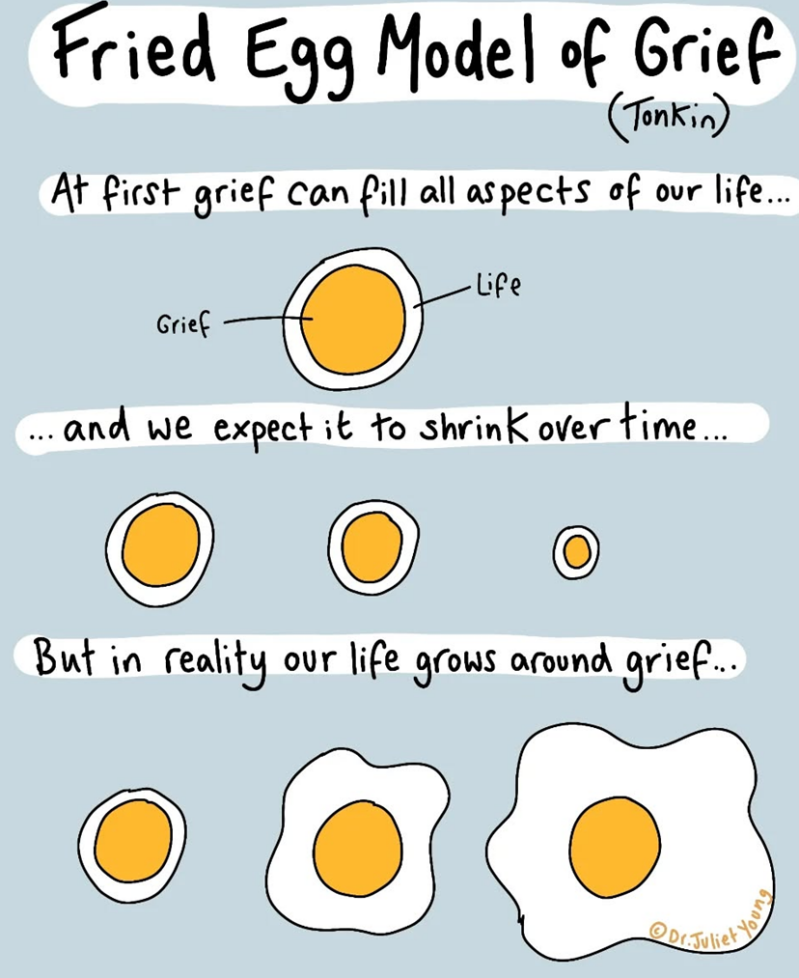
There’s a theory by Dr Lois Tonkin called Growing Around Grief. Often nicknamed the “fried egg” model. Grief doesn’t shrink - life grows around it.
The yolk represents the loss: the person‑shaped, situation‑shaped hole. The pain doesn’t disappear. The egg white - the world continuing regardless - expands. Life moves on. Needs persist. Relationships, routines, responsibilities carry on, whether we want them to or not.
Eventually, it can look like the grief has shrunk. But it hasn’t. We’ve just grown around it.
Because the world doesn’t stop spinning - not for anyone.
And then someone else dies.
Suddenly that neat little diagram feels laughably inadequate. Because grief is never a stand‑alone event. Every new loss tugs at the edges of the old ones, stretching the yolk wider, reopening cracks we thought had healed. After enough loss, the yolk can stop feeling circular and start feeling like a fucking massive sinkhole, swallowing the egg white around it.
It’s messy.
It’s unfair.
It’s human.
Something else has been rattling around my head too: Why do we wait until someone dies to say the things we actually mean? Why are eulogies full of words we never dared to say aloud while people were alive?
Maybe it’s because we don’t know who will die next. Maybe because the list of people who matter is impossibly long. Maybe because trying to say everything just in case is unrealistic – at times, I’ve tried but frankly I was de-lu-lu-lusional!
Grief doesn’t care about logic.
It hijacks the amygdala, floods us with guilt, and drowns out rational rebuttals. It tells us we should have done more. Said more. Been more. Even when we didn’t fail anyone at all.
Most of us know that bitter cocktail well - guilt, sadness, anger, confusion, love, longing.
There are no neat answers here. No tidy psychological bow to tie around it.
What I do know is this: talking about loss of experience and about the people who don’t walk beside me anymore does something. It keeps them stitched into the fabric of my life. It softens the edges of the yolk - not shrinking it, and why would I ever want that anyway?
Maybe the answer is writing eulogies for the living.
Maybe it’s carving names into benches.
Maybe it’s none of that.
Maybe it’s all of it.
Or maybe it’s allowing ourselves to speak their names, tell their stories, and let our lives grow around the grief - without pretending the grief disappears. Because it doesn’t.
It really bloody doesn’t. And that’s okay… or so they say – either way, it’s unchangeable.
I don’t have the answers. I’m not sure anyone does. But if you feel like you need to speak to someone about loss of something or someone - about living or dying - please reach out. Personally. Professionally. Whenever and however you can.
Do it in your space, at your pace and remember, you are never alone.
www.chambersofchange.com
Add comment
Comments